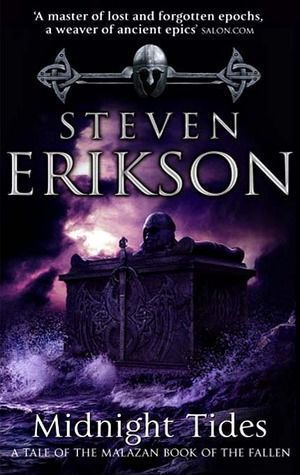
Guess who’s back, back again? Else’s back, with another Malazan reread blog post. It is time to talk about The Bonehunters, part 6 in the Malazan Book of the Fallen. We’re back in Seven Cities, right after the events of Midnight Tides. Following the 14th Army while they try to round up the last of the rebellion.
For this installment of my reread, I want to get into focalisation and how it can be (creatively) used to give readers more information than characters, or to withhold information for the readers for later revelations. Maybe by literature degree is finally going to help me with my job…
Who is focalising, the focalisation of a text, is basically “whose point of view are we reading.” Not in the sense of first person singular, third person singular, sometimes second person singular or, even rarer, a plural narration. This is more about whose thoughts and actions are open to the reader. A book can have multiple characters for whom we have access to their thoughts, a single character, no character, or even all of the characters. Basically: whose point of view are you experiencing.
Erikson plays a lot with focalisation throughout the book. In battle scenes, he likes to jump around so you get an overal impression of how the battle is going. During non-battle scenes, Erikson likes to jump through different characters who might not even be on the same continent at that time. This can cause quite a bit of confusion for the unseasoned readers, but adds some fun and excitement for us veterans. In general, Erikson uses focalisation to either withhold information from the readers, or give readers more information than certain characters. This way, Erikson creates tension by not giving readers and characters the same information, until events unfold.
The Bonehunters is another level of masterclass in focalisation from Erikson. We get access to a lot of characters and their internal struggles, what they are doing, what is going on. But the characters we don’t get access to, like Adjunct Tavore, are the ones who are also distant from the people around them. The Adjunct is this unknowable person, both for the characters in the book and for the readers outside the story. While she makes all the important decisions for the 14th Army, neither the soldiers nor the commanders, really know what she is thinking, and what her grand strategy is. This creates distrust from both the reader and the characters themselves. But because Adjunct Tavore is unknowable, we never get access to her defense of her tactics or the decisions she makes. We only read about the outcome of those events and decisions. This leaves characters and readers alike wondering if she is a tactical genius… or if she just does whatever.
By jumping between different characters, we also get a grander scope on the events going on in the wider world. The narrative is not just stuck on one person’s journey who has to find out what is going on, but we get the idea of a large world existing, with people living and trying their best to get through the day. The one time Erikson breaks from this multi-person focalisation is at the start of House of Chains. With that book, we were forced into the head of Karsa Orlong for the start of the series, forming a large contrast with Erikson’s earlier style. Later in the book, though, he reverts back to switching between characters again.
Personally, of course, I am a huge fan of this style of multiple narration, otherwise these books would not be my favourite fantasy series of all time, but I have heard other people who are not as keen on switching between characters, which of course is valid and reasonable, but offers a much narrower view on worlds in my opinion. Which can be an asset or a disadvantage.
I am on to my favourite book of the series, Reaper’s Gale, and I will see you soon in the next installment.