Our partner JAI not only invites the brightest U.S. minds to the Netherlands, but also maintains a thought-provoking blog, where they analyze the current affairs and democratic history of the U.S.A. through essays and interviews. From time to time we will repost some of their articles here, with their permission. This article has been first published on their blog on 15 April 2026.
The Constitutional Mechanism for Removing a President That Has Never Been Invoked
Somewhere in the National Archives is a letter that was never signed. It would have removed a sitting president from power. It was drafted, reviewed, and quietly put away — one of several moments in the past sixty years when the United States came to the edge of a constitutional precipice and stepped back.
Section 4 of the Twenty-Fifth Amendment gives the Vice President and a Cabinet majority the power to remove a sitting president against his will. It was ratified in 1967. It has never been invoked. In the nearly sixty years since, the country has lived through assassination attempts, constitutional crises, and moments of genuine alarm about the fitness of the men holding the office — and each time, the amendment has remained untouched.
The reasons why tell a story of their own. A Defense Secretary convinced the president could not be trusted with the nuclear arsenal, routed launch orders through himself rather than trigger the amendment’s procedures. A Chief of Staff arrived at the White House prepared to invoke Section 4, observed the president for a single day, and walked away. A Speaker of the House formally requested that a Vice President and the Cabinet act — in writing — and received a formal refusal. The mechanism designed for the gravest of constitutional emergencies has, in practice, functioned as a last resort that no one will resort to last.
The mechanism itself helps explain why. To remove a president against his will, the Vice President and a majority of the Cabinet must first declare him unable to discharge his duties — a step that requires the president’s own closest lieutenants to act against him. If he disputes the finding, he need only send Congress a written declaration to the contrary, at which point he resumes power unless two-thirds of both chambers vote within twenty-one days to keep him removed. That supermajority has never been achieved against a sitting president in American history. The amendment does not merely require political will. It requires political will of a kind the system has never produced.
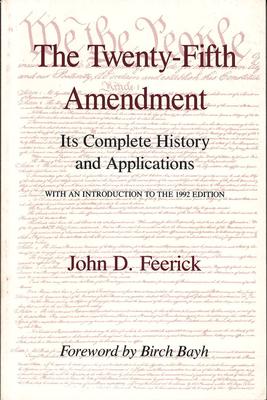
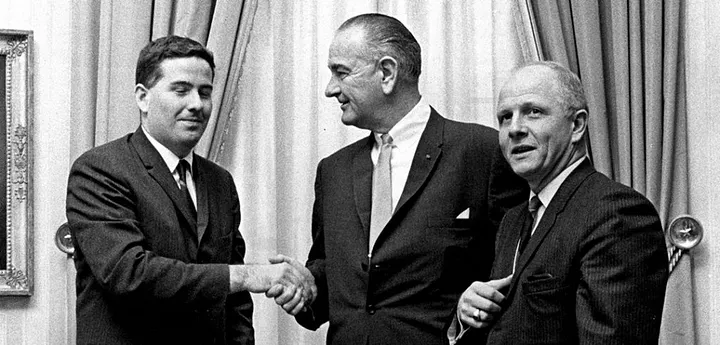
John D. Feerick was in the room when the amendment was written. A young Fordham-trained lawyer in 1963, he published his first article on presidential succession weeks before Kennedy was assassinated and Johnson was sworn in with no Vice President and no way to appoint one. He collaborated directly with Senator Birch Bayh, the amendment’s chief architect, helping shape the language ratified four years later. His scholarship became part of the Senate’s official record. He has spent six decades as its foremost living interpreter.
At 89, Feerick is not just a scholar of the amendment. He may be one of its last witnesses. John D. Feerick spoke with Sean Cotter-Lem of the John Adams Institute via email in April 2026. What follows is that exchange, lightly edited for clarity.
Sean Cotter-Lem: You published an article on presidential succession in the Fordham Law Review in early 1963, and a letter in the New York Times on November 17th warning that Congress needed to act. What was the state of the conversation in Washington at that point?
John D. Feerick: Congressional hearings on presidential succession in both Houses of Congress during the Eisenhower years and the Kennedy presidency had studied the subjects of presidential inability and a vacancy in the Vice Presidency without coming to a resolution. My letter called attention to the issues involved with previous disabilities of Presidents and ambiguities in the Constitution and the need for Congress to act on the subject.
SCL: Five days after that letter, Kennedy was dead. What did that moment feel like to someone who had just written about exactly this gap?
JDF: My response to learning of President Kennedy’s death was an emotional one. I cried on the way home that afternoon from a client meeting that day and at times during the weekend, most especially as I watched the funeral procession on television. As I said in my memoir, “Like so many Americans, I took a week to process this national tragedy. Kennedy, the grandson of Irish immigrants and the first of his faith to be elected president, was my hero.” On receiving the ABA Medal in 2017, I said in my acceptance: “His tragic death… felt like the loss of a family member.”
SCL: Senator Birch Bayh was the key legislative champion. What was your working relationship with him, and how much did the amendment change through the process from what you’d originally envisioned?
JDF: I came to meet Senator Bayh, the key architect of the Twenty-Fifth Amendment, at the American Bar Association Conference of January 20 and 21, 1964, where his proposal in Congress was discussed, along with other proposals, arriving at a series of resolutions by the ABA to recommend to Congress bearing on inability and a vice presidential vacancy. I sat next to Senator Bayh at that meeting and came to know him and thereafter collaborated with him through principally his staff counsel, Larry Conrad, as an individual volunteer and chair of the ABA’s Young Lawyers Committee on Presidential Inability and Vice-Presidential Vacancy. I had a similar collaboration with Richard Poff of Virginia, who played a major role in the development of the Amendment in his House of Congress. The general thrust of the amendment, covering an “inability” and filling a vacancy in the Vice Presidency was decided by the spring of 1964, when the line of succession reform was removed from Senator Bayh’s proposed amendment. Many additions in the wording of the amendment occurred over the next year in both Houses of Congress, including from a Conference Committee of both Houses, chaired by Senator Bayh.
SCL: The amendment’s central phrase — “unable to discharge the powers and duties of his office” — has always been contested. Was the ambiguity intentional, or unavoidable? And do you think there’s still a shared national understanding of what it means?
JDF: As for a national understanding of the expression “unable to discharge the powers and duties of his office,” the question assumes a careful reader of the Twenty-Fifth Amendment. The use of the specific words “unable to discharge” in Sections 3 and 4 were added by Senator Bayh to the wording of the then proposed amendment in 1965 to make clear that a Vice President serving as an Acting President not only has the powers and duties of the presidency but should discharge them as well.
SCL: When drafting Section 4, you contemplated extreme scenarios: a president kidnapped or incapacitated under enemy attack. Was a president who was behaviorally or cognitively unfit — but not physically incapacitated — part of those conversations?
JDF: In the long development of the amendment beginning in 1955 in the House Judiciary Committee and extending to hearings in both Houses of Congress in the following years, many inability contingencies were discussed, including physical and mental disabilities, total or temporary. During the Eisenhower years in the Senate hearings his attorney generals also discussed a President who was insane. In my book, From Failing Hands, with respect to the 1958 Senate hearings of the Subcommittee on Constitutional Amendments of the Senate Judiciary Committee, I summarize the views of former Attorney Generals Herbert Brownell and William P. Rogers regarding the case of an insane President. The discussion focused on the remedy for such a case, with Rogers suggesting that the Vice President, with the approval of a majority of the Cabinet, could bring before Congress any disagreement he had with the President.
SCL: You’ve argued against an independent medical panel to assess presidential inability, on the grounds that it violates the separation of powers. Do you still hold that view?
JDF: My view remains, as stated in my writings and in testimony I gave before Congress in 1964, that keeping the decision within the executive branch, the joint responsibility of the Vice President and Cabinet, is preferable but I also support the provision in the Twenty-Fifth Amendment giving Congress the authority, as stated by Bayh, “to establish some other body to act with the Vice President.” This provision was recommended by the conferees at the American Bar Conference of January 20–21, 1964, of which I was a member.
SCL: When Bayh referred to “some other body to act with the Vice President: — what did he have in mind, and what would the composition of such a body look like?
JDF: Senator Bayh spoke generally of “another body”, believing the Cabinet was the appropriate body, stating in his testimony before the House of Representatives in 1965: “There was no precedent or constitutional provision such as we are trying to provide. We put the Cabinet in there because we feel this is the group which is best able to protect the President from a power-hungry Vice President and the group which is most intimately associated with his official status. It is a thorny problem.”
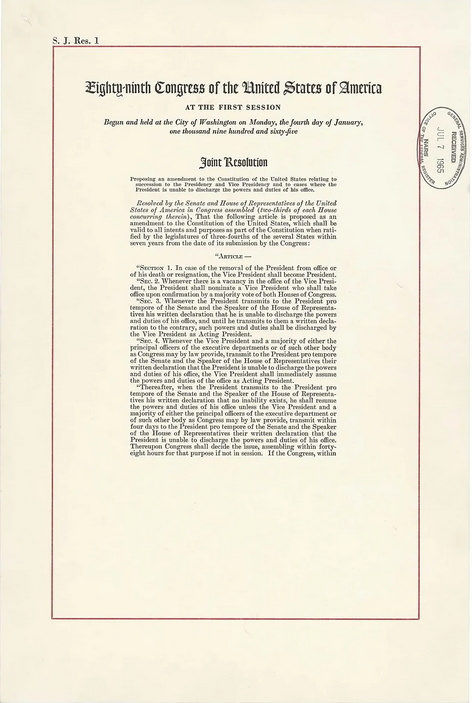
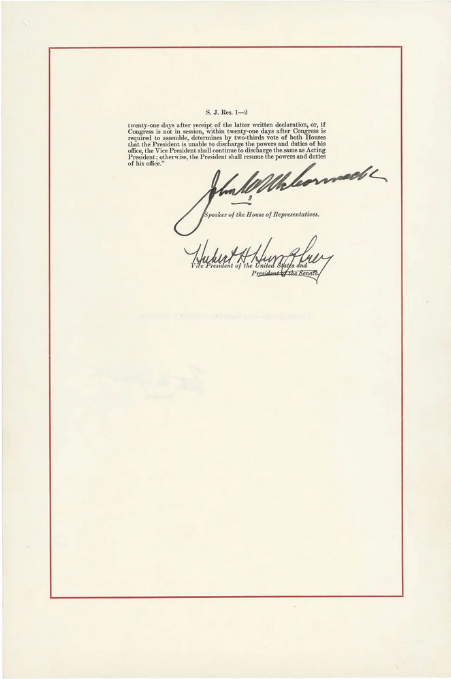
Joint Resolution Proposing the Twenty-Fifth Amendment to the United States Constitution NAID: 1415077
SCL: The Nixon years were the amendment’s first real stress test. When Agnew resigned, Ford was appointed Vice President under Section 2 — and when Nixon resigned, Ford became President with Rockefeller as his appointed Vice President. Nobody had voted for either of them. What did that period reveal about what the amendment could and couldn’t do — and does the largely routine use since then feel like success, or does it mean the genuinely hard cases remain unaddressed?
JDF: These uses of the Amendment gave stability to our country and enabled the country to move beyond the crisis that had occurred and damaged the nation called Watergate. Subsequent uses of Section 3 of the Amendment occurred during the administrations of three presidents, Presidents Ronald Reagan, George W. Bush, and Joseph Biden, when they underwent surgeries under general anesthetic. As Senator Bayh reflected in an exchange in the Senate with Senator Kennedy on June 30, 1965, “A President who was unconscious for 30 minutes when missiles were flying toward this country might only be disabled temporarily, but it would be of severe consequence when viewed in the light of the problems facing the country.”
SCL: In Watergate: A New History, Garrett Graff reports that fearing a “berserk” Nixon might unilaterally trigger nuclear armageddon, Secretary of Defense James R. Schlesinger alerted military leaders to confirm any presidential launch orders with himself or Kissinger directly. Schlesinger was one of the Cabinet officers Section 4 was written for. He didn’t invoke the amendment but rather went around it entirely. In your view, was Schlesinger right to do what he did?
JDF: I have not read Garrett Graff’s Watergate: A New History but take your summary to be factually accurate. I am reminded of Herbert Brownell’s observation in a Yale Law Review article in 1958 entitled Presidential Disability: The Need for a Constitutional Amendment that, “not every contingency can be addressed specifically in law and those who serve need to judge what is best for America at such times.”
SCL: After the events of January 6th 2021, Speaker Pelosi publicly called on Vice President Pence to invoke Section 4. Was that a legitimate application of the amendment — and does a Vice President have any obligation to formally consider it when Congress is demanding action, or is it purely discretionary?
JDF: When the House of Representatives called on Vice President Pence to invoke the Twenty-Fifth Amendment, he had no authority to do so on his own, but as Bayh said in testimony he gave before the House Judiciary Committee in 1965, in speaking of the roles of the Vice President and members of the Cabinet: “Either one can pose the question and the other can concur therein.”
SCL: Pelosi wasn’t asking Pence to act alone — she was asking him to mobilize the Cabinet, in Bayh’s words “pose the question”. He refused. Pelosi argued that January 6th demonstrated “absolute inability to discharge the powers and duties of office.” Pence replied that invoking the amendment in such circumstances would set a dangerous precedent. In your assessment, who was right?
JDF: When the House of Representatives called on Vice President Pence to invoke the Twenty-Fifth Amendment, less than two weeks remained in the President’s four-year term. Even assuming the Speaker was correct, a determination of inability by the Vice President and Cabinet would undoubtedly have been challenged by the President, creating further turmoil at a most difficult time. I leave the assessment of each for others to discuss as I have made it a practice to educate others concerning what I understand of the Amendment and not to apply it as such in situations involving our recent presidents.
SCL: President Trump recently posted on Truth Social that “a whole civilization will die tonight, never to be brought back again,” as he threatened to destroy Iranian civilian infrastructure. More than 85 members of Congress called for his removal, some citing impeachment, others specifically calling for Section 4 to be invoked. Does threatening rhetoric — language legal scholars are now parsing against the Genocide Convention — even meet the amendment’s threshold? Or is it simply not built for this kind of situation?
JDF: As to the meaning of “inability” under section 4 of the Amendment, I turn to the words of Senator Bayh in the Senate debates of February 19, 1965, where he said: “the word ‘inability’ and the word ‘unable’ refer to an impairment of the President’s faculties, mean that he is unable to either make or communicate his decisions as to his own competency to execute the powers and duties of his office. I should like for the RECORD to include that as my definition of the words ‘inability’ and ‘unable’.” In the Senate debate of June 30, 1965, on the adoption of the conference committee report, he added: “We are not getting into a position, through the pending measure, in which when a President makes an unpopular decision, he would immediately be rendered unable to perform the duties of his office.”
SCL: By that definition, a president who makes decisions his Cabinet finds alarming — even catastrophic — but who is clearly capable of making and communicating them, falls entirely outside Section 4’s reach. Is that correct?
JDF: Senator Bayh explained in his exchange with Senator Kennedy on June 30, 1965, that “we are talking about inability to perform the constitutional duties of the office of President. “He also said that an inability was “one that would seriously impair the President’s ability to perform the powers and duties of his office.” He also opined that the Cabinet as well as the Vice President and Congress “are going to have to judge the severity of the disability and the problems that face our country.” And, he said, “if the president were unable to make an executive decision which might have severe consequences for the country, I think we would be better off under the conditions of the amendment.” In a subsequent reply to a question posed by Senator Kennedy: “The Senator realizes the complications for the people of the country and the world under these circumstances[?]” Bayh [replied]: “I do, indeed. I also recognize our difficulty, if we had no amendment at all.”
SCL: Section 4 has never been invoked. If a president accepted a declaration of inability, the transfer of power would be straightforward — but if he contested it, two-thirds of both chambers of Congress would be required to keep him from resuming office. Is that threshold so high that the amendment becomes inert in precisely the scenarios that seemingly most demand it?
JDF: The views expressed in Congress, in the discussions during the presidencies of Eisenhower and Kennedy, was that two thirds vote, as in a removal after an impeachment vote by a House majority should be required to remove a President from his powers and duties under the Twenty-Fifth Amendment. This was seen protective of a President chosen by the people of the country for a four-year term. In describing scenarios covered by the Twenty-Fifth Amendment, using examples such as a serious operation and a heart attack, Senator Bayh said “these would be 90 percent of the disability occurrences.” As for the remaining 10%, he said, there is “sufficient protection” in the amendment as “against usurpation of power. There isn’t any way to make this seem as if it wouldn’t be a tangled mess in the press or any place else.” He then added: “May I suggest that the damage to the President as an individual is not so important as the safety of the country […] If the Congress finds that the Cabinet cannot adequately fill this role, then it provides an alternative body that will function. This is the way we intended it.”
SCL: You once called the Twenty-Fifth Amendment “the safety net of the American Constitution.” Watching how it’s been invoked in political debate since ratification, does that net feel like it’s holding? Looking back at the young lawyer who helped write it — what did he fail to anticipate?
JDF: As for the amendment being a safety net of the American Constitution, I continue to adhere to the view expressed by Senate Majority Leader Michael Mansfield of Montana when the amendment was first approved on September 28, 1964: “It is a foundation which will set well in the building which is this republic.”
SCL: I’ll ask more directly — do you worry the amendment you helped write is inadequate for the present moment?
I believe the amendment is more than adequate for the present moment. Sections 1, 2, and 3 have worked as intended and remain important in the “building which is this Republic.” Section 4 remains untested but provides in it a means of changing by statute the Cabinet as the body that has the joint responsibility with the Vice President. Senator Russell Long of Louisiana said on July 6 1965, in supporting the amendment, that he might have preferred some changes be made, but the advice he received was, “don’t muddy the water. If we start all over again, other Senators will have suggestions to make, and we shall be another 100 years getting to the point which we now have reached.” Senator Sam Ervin of North Carolina noted on that day as well that the amendment was the best obtainable in Congress as it was “then constituted.” It contains a provision in Section 4, the text discussed in the media at this time, that allows for a major change by Congress, in its wisdom. As for me, I remain very affirmative regarding an amendment to the United States Constitution with which, as Senator Bayh, said, enabled me to “provide a “guiding hand throughout the process of crafting the Amendment, obtaining its approval by Congress and ratification by the states, and implementing it for the first time.”
The Twenty-Fifth Amendment was designed as a safeguard for moments of genuine presidential incapacity. But in practice, its elaborate choreography has made it something closer to a constitutional Rube Goldberg machine: intricate, carefully constructed, and extraordinarily difficult to set in motion when it matters most. It does not just require crisis, but consensus; not just alarm, but agreement on what rises to the level of inability. In the absence of both, the mechanism remains still. That unsigned letter is not simply a historical curiosity. It is a reminder that even the most carefully engineered constitutional safeguards ultimately depend on something far less predictable: the willingness to use them.
About the author:
SEAN COTTER-LEM is the Program & Community Coordinator of the John Adams Institute, Amsterdam’s premier platform for independent American thought, convening consequential public figures for dialogue and debate.
Find out more about the subject: