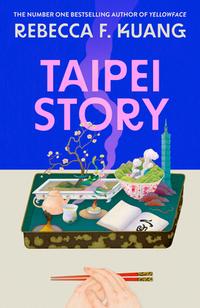
Taipei Story by Rebecca F. Kuang
Yale student Lily Chen arrives in Taipei hungry: for family, for culture, for connection.
But her summer of discovery quickly unravels. Her classes are grueling, her roommate unbearable, and a reckless, deeply awkward trip to the hot springs with a guy she barely knows soon ignites vicious gossip.
Then her grandfather dies. Grieving and adrift, Lily must confront her own questions about the culture she inherited but never fully understood. She embarks on a wryly funny, often devastating search for understanding: of herself, her family, and the meaning of home.
All over one unforgettable summer in Taipei.
by Damla
“This rupture was very freeing. It absolved anything I saw from the burden of significance. I was not homecoming and I was not a tourist. I was just a student, and I was living in a city among two and a half million other people, many of whom loved Listz, just like me, and we were all calling this place home, for now.”
Another homerun from R.F. Kuang, in my eyes.
Taipei Story is classic Kuang, simultaneously reflective and wryly humorous with lots of academic emphasis. Her writing always has so much depth, so much complexity of emotion, that her protagonists always feel startlingly real. Even though they’re usually hard-to-like personalities, you can’t help but try to understand them and invest in the outcomes of their actions. Pair that character work with a purposefully uncomfortable and immersive atmosphere, and you’ve got that Kuang signature. The suffocating climate, the unrelenting heat and humidity, the alienating gloom all contribute to that immersion.
And talking of classic Kuang, besides her writing style, her latest story is of course also centered around language. More specifically, language as the key (and thus the obstacle) to connecting to your past, your present, and to your surroundings. In Taipei Story, the main character Lily, who was born and raised in the USA, enrolls in an intense summer language course to better her Chinese, with hopes of building a bridge to her somewhat estranged family in China. During the month-long program, she wrestles with the treacherous twists and turns of a complex language along with the shame and guilt of having complied all these years with the Western colonization of her cultural roots. There is a lot of social and political background on Chinese and more importantly Taiwanese history interwoven with the story, which I found to be very interesting. Leave it to Kuang to present the nuanced complexities of a region in political upheaval without making it a boring history lesson.
Overall, I thought that Kuang really succeeded in conveying the nervous energy of finding yourself somewhere new, carrying the burden and the effort of proving yourself, wrestling with the impenetrable cultural and language barriers, and fighting that imposter syndrome against the constant shifting ground of learning a new language, in both the philological and the cultural context. It is a feeling that is all too familiar: attempting to be a part of something and finding yourself lost with every corner turned. Although the pacing is a bit slow at times, it nonetheless delivers a masterful story examining human complexities and connections.
I think this book will hit harder with readers who have a similar background, perhaps with immigrants who are stuck between assimilating to their new home and staying connected to their historical roots. But even without that experience, this book delivers a masterful story examining human complexities and connections.