by Iris

A few years ago, I fell completely in love with novellas. I’d read a couple before (To Be Taught, If Fortunate by Becky Chambers comes to mind), but I guess not enough of them to fully appreciate the form. Or maybe it was just a timing issue? But at some point during the Covid years – and I remember this vividly because I started reading The Empress of Salt and Fortune by Nghi Vo during the mandatory 15-minute waiting period after my first Pfizer shot – I started absolutely inhaling novellas. Could it have been a side effect of the vaccination? Probably not, but I guess we can’t really say.

Anyway. The skill with which authors can evoke a whole city, country, world or even universe, and also build a fully-fledged plot in 160 pages or so continues to blow my mind. But while I love their diminutive size, that is also exactly what makes it hard to review them. How much can you really say about such a short book without spoiling crucial plot points? So here’s an experiment: three micro reviews in one post! These ones are all about near-future dystopias (I know, I know, keeping it light).
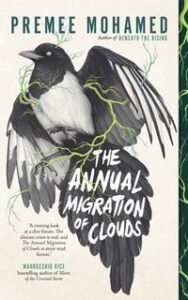
The world is nothing like it once was: climate disasters have wracked the continent, causing food shortages, ending industry, and leaving little behind. Then came Cad, mysterious mind-altering fungi that invade the bodies of the now scattered citizenry. Reid, a young woman who carries this parasite, has been given a chance to move to one of the last remnants of pre-disaster society – but she can’t bring herself to abandon her mother and the community that relies on her.
Climate disasters have ravaged the continent, and survivors eke out a living in the remnants of the old world. A classic cli-fi, but with a twist: a portion of the population is now infected with Cad, a behavior-altering fungal parasite. It is largely dormant, but can “go off”, usually killing its host. We follow Reid, a young woman in a small community living a hard life in a former university campus. But Reid has received an invitation to a school of sorts, a mysterious place that may hold answers. The catch: no one in her community can say for sure if this place is even real.
The story is written in first person, and I absolutely loved Reid as a narrator. She is observant with a poetic streak, smart, and somewhat pessimistic (which isn’t unreasonable given, you know, the end of the world). Reid has Cad, and it’s interesting to see how that affects her: the parasite wants its host to survive, of course, so it punishes risky behavior. Reid finds herself sometimes unable to move, unable to speak out, unable to come to someone else’s aid. She clashes with her mother, who also has Cad, and wonders how much her mother’s actions are influenced by the parasite.
The type of dystopia in this story is bleak: cold winters, failed harvests, scant resources. But even though the people can be pretty harsh, it’s emphasized how integral every part of the community is to its overall survival, and how Reid (a young, capable person) leaving would mean a significant drain. The contrast with the mysterious school she’s been invited to, allegedly one of the last remnants of pre-disaster society, is enormous. At its core, this is a story about facing a difficult decision whose consequences you may not be able to grasp entirely until you’ve already made the call, and I think it’s beautifully done.

cover of These Fragile Graces, This Fugitive Heart by Izzy Wasserstein

In mid-21st-century Kansas City, Dora hasn’t been back to her old commune in years. But when Dora’s ex-girlfriend Kay is killed, and everyone at the commune is a potential suspect, Dora knows she’s the only person who can solve the murder. As she begins her investigations, she discovers that a strange new drug is circulating. People are disappearing. And Dora is being attacked by assailants from her pre-transition past. Now she must uncover a twisted conspiracy, all while navigating a deeply meaningful new relationship.
This gritty, noir technothriller is set in near-future Kansas City, where government has collapsed. Class rifts are becoming more extreme, and many people are reduced to crime and theft in order to survive. Dora used to be part of an anarchist commune, banding together for better chances, but she left in a way that burned quite a few bridges. Now, though, her ex-girlfriend, one of the founders of the commune, has been murdered. Dora also finds herself under attack by a series of assassins with familiar faces from her pre-transition past.
I found myself racing through this book and rooting for Dora pretty much from page one. The larger setting is grim: a polluted world in which resources are becoming more and more scarce – though really only if you belong to the unfortunate have-nots. On a smaller scale, things are tricky as well. Dora’s former commune seems to have been a safe place of well-intentioned people, but is now tense with layers of resentment.
The part of the story I liked best, though, is difficult to talk about without spoiling anything for future readers. Suffice it to say that a beautiful and tender (if somewhat surprising) connection forms between Dora and one of the people ostensibly on the other side of good and evil. It’s a fascinating exploration of identity, and what it means to make your own decisions. Inspiring stuff!

The rain in Aloisville is never-ending, and no one can remember when it started. There’’s not much they can remember. With every drop that hits their skin, a bit of memory is washed away. By the time Laverne begins keeping a journal, the small town she calls home has been irreparably changed. With mysterious forces preventing escape, calls for rebellion seem to be on every resident’s lips. But Laverne has no interest in fighting. She just wants to survive.
It’s been a while since I first read this book, but I still find myself thinking back to it quite regularly. Maybe it was just one of those ‘right place, right time’ kind of things, because for me, this story hit the spot exactly. It’s quite short, even for a novella, tipping the scales at a mere 96 pages. But it packs a punch that many full-length novels don’t seem to manage. There are several intriguing twists in this book, and the reveal at the end actually made me scream out loud.
This form of dystopia is mysterious: clearly, the world has changed in a fundamental way that means something will probably be different forever. But we never learn all that much about the amnesia-inflicting rain. Where did it come from? How big is the affected area? Could it be an experiment of some kind? Is anyone actually trying to fix it? It’s disorienting, because there’s no real way for anyone exposed to know what they’ve lost. Added to the unrest on a smaller scale, with a bunch of locals planning their own thing, it makes for a very tense atmosphere in which eventual combustion is inevitable.