by Sophie
Ada Limón, the 24th U.S. Poet Laureate, and the first Latina to hold the position, will be visiting Amsterdam in March. Our partners the John Adams Institute will host her for an evening, exploring how poetry can hold space for both love and critique, and how words can help forge a nation at odds with itself into something new and more united.
To celebrate Ada Limón we wanted to highlight her various collections, as well as some other poets that combine sharp insights into the now with visions of hope for the future. We hope you’ll be inspired to visit her talk on 5 March!
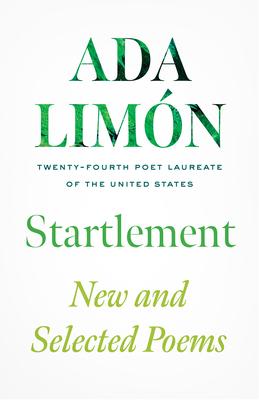
Startlement
An essential collection spanning nearly twenty years of emphatic, fearlessly original poetry from one of America’s most celebrated living writers.
Drawing from six previously published books—including widely acclaimed collections The Hurting Kind, The Carrying, and Bright Dead Things—as well as vibrant new work, Startlement exalts the mysterious. With a tender curiosity, Ada Limón wades into potent unknowns — the strangeness of our brief human lives, the ever-changing nature of the universe — and emerges each time with new revelations about our place in the world.
Both a lush overview of her work and a powerful narrative of a poet’s life, this curation embodies Limón’s capacity for “deep attention,” her “power to open us up to the wonder and awe that the world still inspires” (The New York Times). From the chaos of youthful desire, to the waxing of love and loss, to the precarity of our environment, to the stars and beyond, Limón’s poetry bears witness to the arc of all we know with patient lyricism and humble wonder.
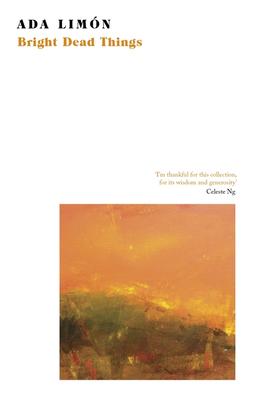
Bright Dead Things
A book of bravado and introspection, of feminist swagger and harrowing loss, Bright Dead Things considers how we build our identities out of place and human contact – tracing in intimate detail the ways the speaker’s sense of self both shifts and perseveres as she moves from New York City to rural Kentucky, loses a dear parent, ages past the capriciousness of youth and falls in love.
In these extraordinary poems Ada Limón’s heart becomes a ‘huge beating genius machine’ striving to embrace and understand the fullness of the present moment. ‘I am beautiful. I am full of love. I am dying,’ the poet writes. Building on the legacies of forebears such as Frank O’Hara, Sharon Olds and Mark Doty, Limón’s work is consistently generous, accessible, and ‘effortlessly lyrical’ (The New York Times) – though every observed moment feels complexly thought, felt and lived.
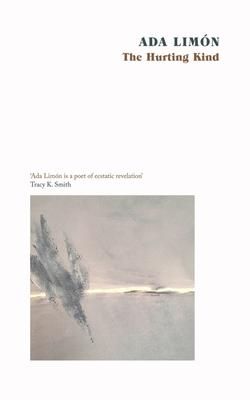
The Hurting Kind
An astonishing collection about interconnectedness – between the human and nonhuman, ancestors and ourselves – from National Book Critics Circle Award winner and National Book Award finalist Ada Limón.
‘I have always been too sensitive, a weeper / from a long line of weepers,’ writes Limón. ‘I am the hurting kind.’ What does it mean to be the hurting kind? To be sensitive not only to the world’s pain and joys, but to the meanings that bend in the scrim between the natural world and the human world? To divine the relationships between us all? To perceive ourselves in other beings – and to know that those beings are resolutely their own, that they ‘do not / care to be seen as symbols’?
With Limón’s remarkable ability to trace thought, The Hurting Kind explores those questions – incorporating others’ stories and ways of knowing, making surprising turns, and always reaching a place of startling insight. These poems slip through the seasons, teeming with horses and kingfishers and the gleaming eyes of fish. And they honour parents, stepparents, and grandparents: the sacrifices made, the separate lives lived, the tendernesses extended to a hurting child; the abundance, in retrospect, of having two families.
Along the way, we glimpse loss. There are flashes of the pandemic, ghosts whose presence manifests in unexpected memories and the mysterious behaviour of pets left behind. But The Hurting Kind is filled, above all, with connection and the delight of being in the world. ‘Slippery and waddle thieving my tomatoes still / green in the morning’s shade,’ writes Limón of a groundhog in her garden, ‘she is doing what she can to survive.’
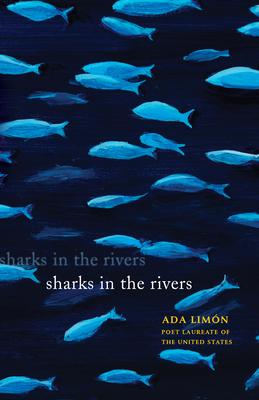
Sharks in the Rivers
The speaker in this extraordinary collection finds herself multiply dislocated: from her childhood in California, from her family’s roots in Mexico, from a dying parent, from her prior self. The world is always in motion both toward and away from us, and it is also full of risk: from sharks unexpectedly lurking beneath estuarial rivers to the dangers of New York City, where, as Limón reminds us, even rats find themselves trapped by the garbage cans they’ve crawled into. In such a world, how should one proceed? Throughout Sharks in the Rivers, Limón suggests that we must cleave to the world as it keep[s] opening before us, for, if we pay attention, we can be one with its complex, ephemeral, and beautiful strangeness. Loss is perpetual, and each person’s mouth is the same / mouth as everyone’s, all trying to say the same thing. For Limón, its the saying – individual and collective – that transforms each of us into a wound overcome by wonder, that allows the wind itself to be our own wild whisper.
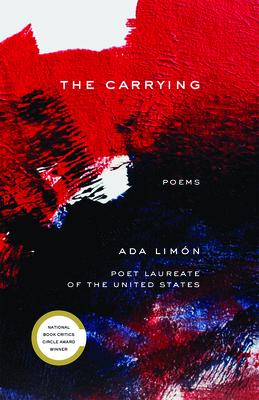
The Carrying
Available for the first time in paperback, The Carrying – winner of the National Book Critics Circle Award and a finalist for the PEN/Jean Stein Book Award – is Ada Limón’s most powerful collection yet.
Vulnerable, tender, acute, these are serious poems, brave poems, exploring with honesty the ambiguous moment between the rapture of youth and the grace of acceptance. A daughter tends to aging parents. A woman struggles with infertility-“What if, instead of carrying / a child, I am supposed to carry grief?” – and a body seized by pain and vertigo as well as ecstasy. A nation convulses: “Every song of this country / has an unsung third stanza, something brutal.” And still Limón shows us, as ever, the persistence of hunger, love, and joy, the dizzying fullness of our too-short lives. “Fine then, / I’ll take it,” she writes. “I’ll take it all.”
In Bright Dead Things, Limon showed us a heart “giant with power, heavy with blood”-“the huge beating genius machine / that thinks, no, it knows, / it’s going to come in first.” In her follow-up collection, that heart is on full display-even as The Carrying continues further and deeper into the bloodstream, following the hard-won truth of what it means to live in an imperfect world.
Other poets you might enjoy if you like Ada Limón’s work:
Amanda Gorman: You might remember her powerful reading of her poem “The Hill We Climb” at Joe Biden’s presidential inauguration in 2021. This first ever U.S. Youth Poet Laureate has one full collection out, Call Us What We Carry.
Audre Lorde: Activist, feminist, writer, lesbian, essayist, mother, poet – Audre Lorde is an icon in many fields. The Collected Poems of Audre Lorde gathers all her poems in one powerful book.
Mary Oliver: One of the great U.S. chroniclers of the beauty and importance of nature. There are many collections in print, but one of the most complete, and selected by Oliver herself, is Devotions.