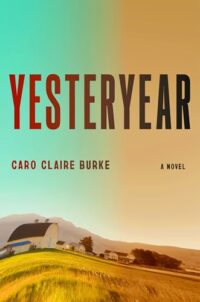
Yesteryear by Caro Claire Burke
Natalie lives a traditional lifestyle. Her charming farmhouse is rustic, her husband a handsome cowboy, her six children each more delightful than the last. So what if there are nannies and producers behind the scenes, her kitchen hiding industrial-grade fridges and ovens, her husband the Republican equivalent of a Kennedy? What Natalie’s followers – all 8 million of them – don’t know won’t hurt them. And The Angry Women? The privileged, Ivy League, coastal elite haters who call her an antifeminist iconoclast? They’re sick with jealousy. Because Natalie isn’t simply living the good life, she’s living the ideal—and just so happens to be building an empire from it.
Until one morning she wakes up in a life that isn’t hers. Her home, her husband, her children—they’re all familiar, but something’s off.
by Sophie
There’s been a lot of buzz around Caro Claire Burke’s debut novel Yesteryear, and it’s been selling like hot cakes, so I of course I wanted to know why, and if I found the hype justified.
The book describes the life and choices of Natalie Heller Mills, trad wife influencer on social media, who lives a seemingly idyllic, back-to-basics life on her farm with her handsome cowboy husband and five children (and a sixth on the way). But the basics are carefully scripted, filmed, and edited by a producer, and modern appliances, not to mention two nannies, hide around the corner. When the façade starts cracking, suddenly Natalie wakes up in a life that is actually back to basics, seemingly 150 years in the past.
The book is told in both the present and through regular flashbacks showing the reader how Natalie turned into a trad wife, as well as how she’s faring when she actually has to walk that walk. I was a little put off by all her “the Lord is good”-like utterings but I’m glad that didn’t stop me from reading it. Burke is a sharp observer, not just of this pseudo-tradwife lifestyle but also of the left-leaning skepticism to it. Natalie is stuck in a box, socialized to within an inch of her life, and can’t see her way out of it, even when opportunities present themselves and people near her gingerly begin to change. It really made me sad for her.
At the same time, she walks into everything with her eyes wide open and her smile/grimace firmly plastered onto her face. So while I might have felt sad for her, I certainly never felt sorry for her. She’s not likeable, but my anger was more at her circumstances (looking at you, patriarchy) than at her. “If only…” I found myself thinking often.
All in all I thought this was a sharp, cynical, uncomfortable, and darkly funny book, and I understand the hype. There’s quite the twist at the end, and it took me a few days after I finished the book to figure out if I liked it or not (I didn’t like it, but it does fit with Natalie’s rigid character). So yes, read it, and find out for yourself! Better yet, read it with a book club, because this tale deserves discussion.