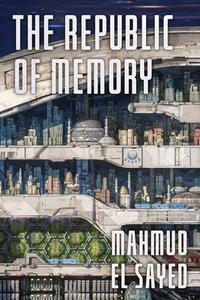
The Republic of Memory by Mahmud El Sayed
A Memory Called Empire meets Children of Time in this Arabfuturist debut set on a generation ship on the brink of revolution as its crew begin to ask why they should toil for a people, and an empire, none of them remember.
The Safina is a city ship halfway through its four-hundred-year voyage from the ruins of Earth to a new colony world. Its crew maintain the ship, generation after generation, while protecting their ancestors in cryostasis so that one day they will be able to enjoy a fresh start under clear blue skies.
But when blackouts start, unrest follows.
by Sophie
A few months ago I was lucky enough to attend a book presentation of We Will Rise Again: Speculative Stories and Essays on Protest, Resistance, and Hope, edited by Malka Older, Annalee Newitz, and Karen Lord. All three editors were there, as was Charlie Jane Anders (who contributed), because why not up the modern science fiction star power even MORE, right? To say I fangirled over all of these amazing humans in one room would be entirely accurate. At some point in the evening they were asked to recommend books, and The Republic of Memory by Mahmud El Sayed was mentioned. “It does stuff with language,” someone said. “If you like Ann Leckie you’ll probably like this.”
Say no more. To the top of the TBR it went. When four award-winning and nominated science fiction superstars recommend a book, I listen.
The Republic of Memory starts with a revolution, 10 years into the 400-year voyage of the generation ship Safina to a new Earth-adjacent planet. (This is not a spoiler, btw, it’s the start of the prologue.) 200 years later, the on-ship society that has evolved since that revolution finds itself stagnant and divided, with unrest bubbling in all berths.
Into this unrest you follow various characters, from a translator to a teenager spoiling for an uprising to an enigmatic underworld leader to a frozen colonist. El Sayed ups the tension well throughout the book, while at the same time also creating an immense but necessarily contained world aboard the behemoth ship. I was regularly taken aback by the size of the Safina – the time it took to travel from one deck to another, or how big and intricate the berths (neighborhoods) were. At the same time, everything is very contained. Not just living quarters but also decks; there are walls and ceilings and access hatches everywhere. El Sayed did a really good job describing life on board. The Safina might be immense, but she’s also very crowded.
I really enjoyed the characters, too, several of whom get their own point-of-view chapter. I found them lovably human. Their struggles with just living in a densely populated space is recognizable, and I enjoyed the debate about whether to honor, ignore, or just jettison the ancestors, cryogenically frozen on many decks to restart a human colony once at their destination, to make space for more housing. I think El Sayed did a good job breathing life into such a diverse group of characters.
There’s also humor and silliness in between all the political scheming and the crime to be uncovered (because yes, something goes pretty catastrophically wrong at some point). I loved the juxtaposition between old and new technologies, too.
And yes, “it does stuff with language.” The nature and function of language is thoroughly probed, not just between differing cultures aboard, but also between different generations of characters. The various groups have trouble understanding one another – hence a translator as a main character. It always tickles me when this happens, because it’s so truthful to the universal lived experience of traveling. (And once again shows the massive size of the Safina.) Whole stretches are also written in Nupol, a language constructed of bits and pieces of all the other onboard languages. “Vali. They want to organize a parley with tu.”, for example. The first few paragraphs were a little taxing, for me, but once I got into the rhythm of it I found I could read it quite well. It certainly kept those grey cells active!
All in all I very much enjoyed this book. I especially loved the non-white, non-Western perspective and cultural markers. The only pity is that I didn’t realize it was a part 1, and now the long wait for part 2 begins…